The short answer
JK Casting casts support brackets, hanger brackets, mounting brackets, cylinder mounts and clamp brackets to the buyer’s drawing or sample, in ductile iron, grey iron or carbon steel, supplied raw or with the pin bores, mounting holes and faces CNC-machined.
Common types
- Support brackets carry a load from below or from the side and pass it into the frame through a mounting face.
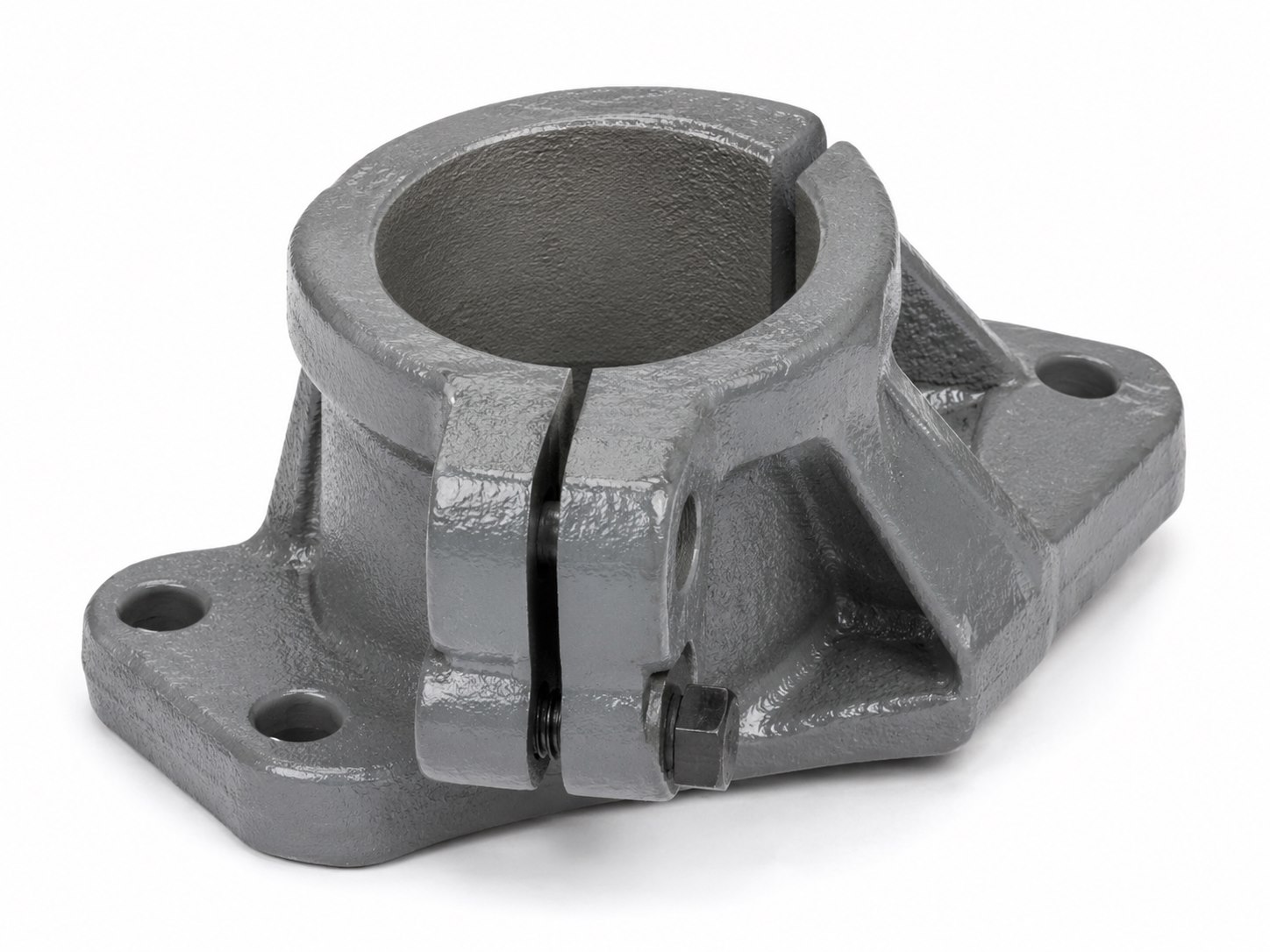
- Hanger brackets carry a part below or beside the mounting point, such as a shaft, bearing, tool bar or linkage, so the load acts on the mounting holes and the hanging bore.
- Mounting brackets and cylinder mounts for construction and heavy equipment, with pin bores and contact faces.
- Clamp brackets and bearing supports for agricultural machinery.
- Brackets and support fittings for pole line and power line hardware; see power line hardware castings.
Materials and grades
- Ductile iron is the usual request when the bracket has to take bending or shock, for example QT450-10 / EN-GJS-450-10 / ASTM A536 65-45-12, or QT400-15 / EN-GJS-400-15 where elongation and impact toughness matter most.
- Grey iron is the usual request for stiffer, simpler shapes where machining and cost matter more, for example HT250 / EN-GJL-250.
- Carbon steel suits most structural brackets when the drawing calls for steel, for example ZG230-450, ZG270-500 or ASTM A27 70-36.
The grade on your drawing governs, and we do not substitute a grade without your approval. See the ductile iron grades chart and the cast steel grades chart.
Casting route
Iron brackets are sand cast, including resin-coated shell moulds where a cleaner surface helps. Smaller steel brackets with ribs and several functional features can be made by investment casting within about 20 kg each, which reduces machining; larger steel brackets are sand cast. Where a bracket is part of a welded assembly, welded fabrications can be quoted together with the castings.
Typical machined features
- Pin bores and hanging bores
- Mounting holes and slots
- Mounting faces and contact faces
- Threaded holes where the drawing shows them
Separate the as-cast geometry, such as ribs and outer surfaces, from the machined interfaces on the drawing.
What to send for a quote
- The drawing or a sample
- The mounting-hole pattern and the bore fit
- The direction of the load and the clearance to moving parts
- The material grade and its standard
- The coating: paint, primer or galvanizing to the agreed specification
- Quantity per part number, the first batch and the expected repeat demand
How JK Casting makes cast brackets
JK Casting, a foundry in Gaomi, Shandong, China, founded in 2002, casts brackets in ductile iron, grey iron and carbon steel as regular materials and CNC-machines the brackets it casts. Each drawing is quoted separately, with tooling and unit price on separate lines. Orders are small to medium batches and repeat deliveries; one- or two-piece orders are rarely economical because a casting needs tooling before the first part is poured.
Related: agricultural machinery castings and support brackets · construction and heavy equipment castings · power line hardware castings
Need this part cast to your drawing?
Send the drawing for a quote — we reply within 24 hours.
Frequently asked questions
What is the difference between a hanger bracket and a support bracket?
A hanger bracket carries a part below or beside its mounting point, so the load acts on the mounting holes and the hanging bore. A support bracket carries a load from below or from the side and passes it into the frame through a mounting face.
Ductile iron or carbon steel for a bracket?
Ductile iron is the usual request for brackets that take bending or shock; carbon steel is used when the drawing calls for steel. The designer chooses the grade, and we confirm feasibility from the drawing.
Can you make a bracket from a sample?
Yes. We measure the sample and prepare a drawing for your approval before tooling. Send the mounting-hole pattern, the load direction, the bore fit, the material and the coating with it.
Do you supply machined brackets?
Yes. Brackets are supplied raw or CNC-machined, with the holes, mounting faces and bores finished to the drawing. The machining scope is confirmed for each drawing.